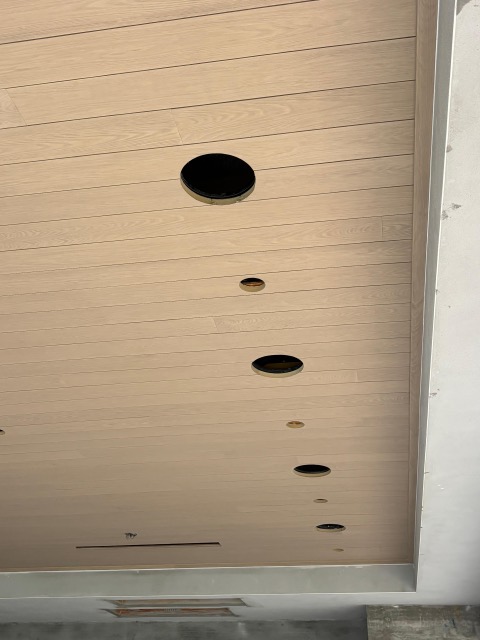
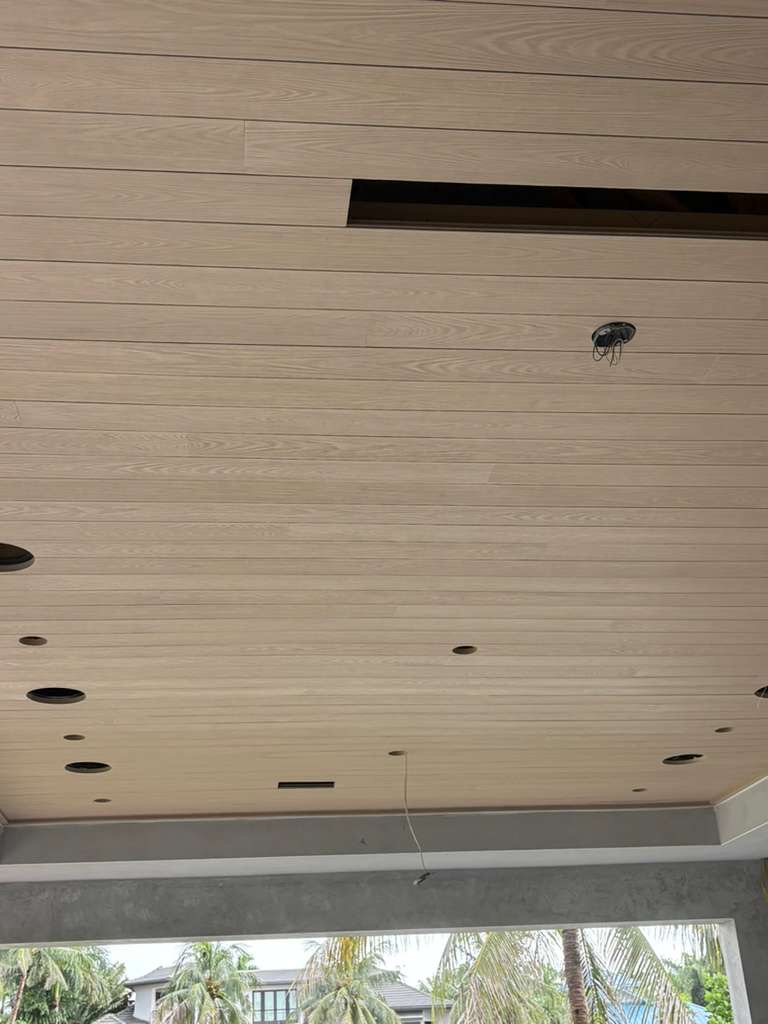
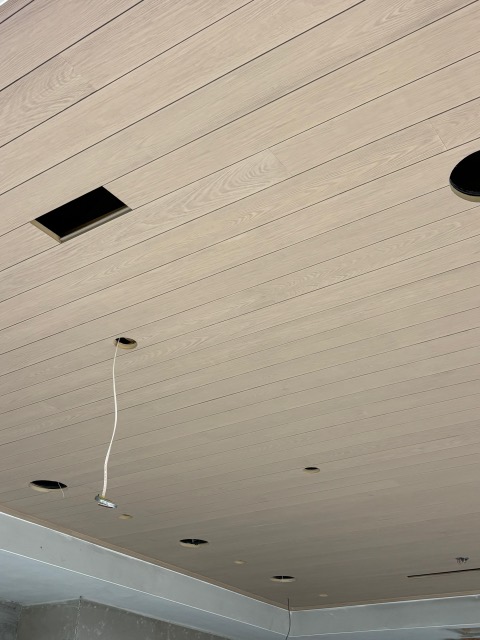
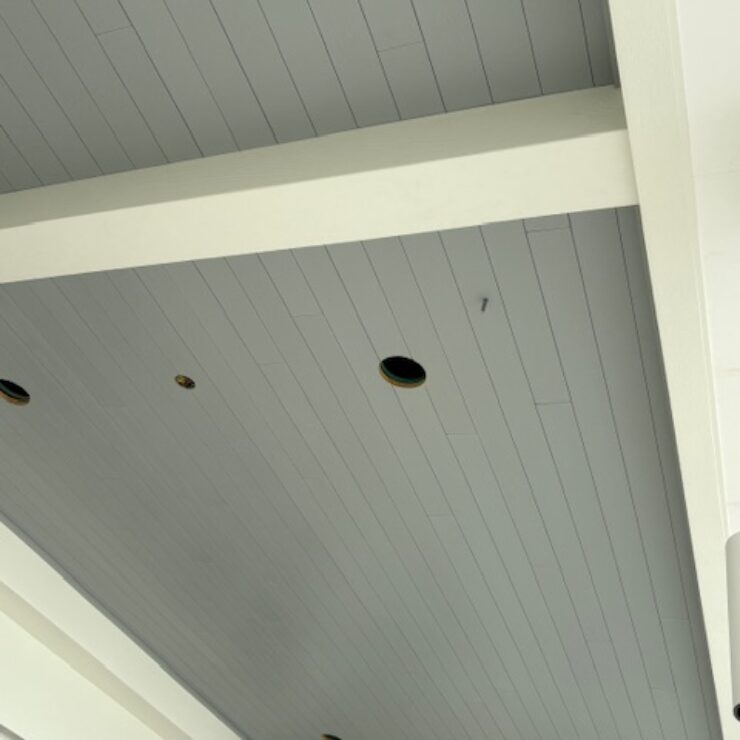
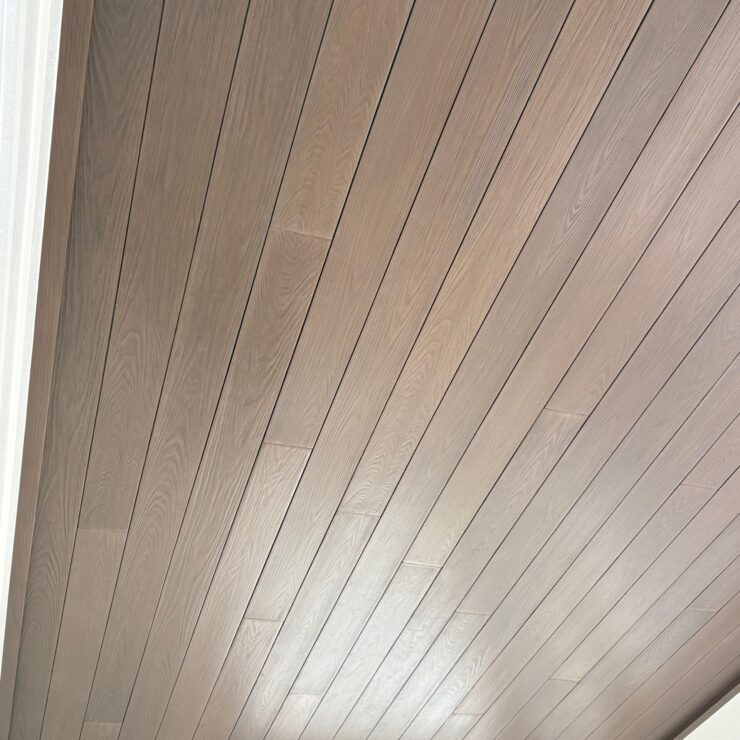
A Shaker Beige Tongue and Groove Ceiling in a Naples Home
A Ceiling Treatment That Stands on Its Own
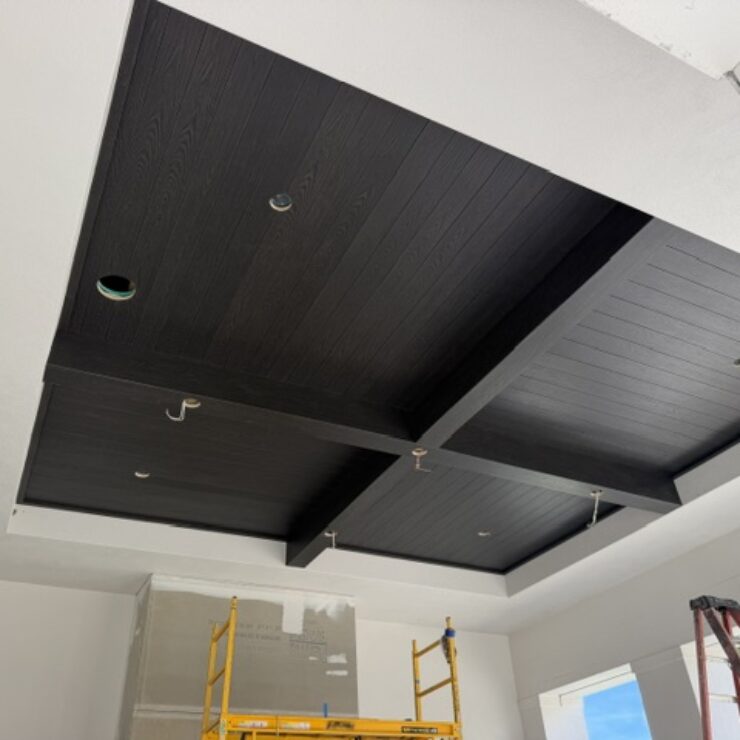
Plank ceilings are usually specified alongside beams, with the planks acting as infill between the members and the beams carrying the visual weight. This Naples project used tongue and groove by itself.
Without beams breaking up the field, the plank run becomes the entire ceiling design. Decisions that would normally be secondary now carry the whole thing: which direction the run goes, how the reveal lines read at a distance, how the field closes out where it meets the wall.
It is a quieter result and a less forgiving one. There is nothing else up there to pull the eye away from a line that is not straight.
Why Shaker Beige Reads the Way It Does
Shaker Beige sits in the middle of the color range, warmer than the grays and considerably lighter than Walnut or Coffee Bean. On a ceiling it holds the wood character of the select cypress grain without committing the room to a rustic look.
That middle position is the practical argument for it. A ceiling is the surface a homeowner is least likely to change, and a color that works under a wide range of wall and floor tones is still working five years after the paint downstairs has been redone twice.
The texture supplies the detail the color does not. Select cypress is a refined grain, which is what keeps a light finish from flattening out into something that reads as painted board rather than wood look plank.
Plank Layout and the Lines You Actually See
A tongue and groove ceiling is read as a set of parallel lines before it is read as wood. Run direction is the first decision and the one with the most effect on the room, since planks running the long dimension stretch a space and planks running the short dimension widen it.
The planks cut and trim with standard carpentry tools, so a run can be adjusted in the field around a can light, a fan box, or a soffit return without waiting on a special order. Individual pieces are light enough for one installer to hold in position while fastening.
Perimeter cuts are where a plank ceiling shows its quality. Consistent piece dimensions keep those closing cuts even down both edges of the room, which is the detail a builder notices first and a homeowner notices eventually.
Choose a Plank Texture and Color for Your Ceiling
Planks are manufactured in the same texture and color range as our beams, with custom color matching available when a project has to hit a specific finish. They install on interior ceilings and covered exterior ceilings alike, with no change in specification between the two.
See the options on our faux tongue and groove ceiling planks page, or send us the ceiling dimensions and we will return a plank count along with a recommended run direction for the space.